Steering Actuator
The steering actuator is responsible for positioning the front wheels at the desired steering angle. It consists of a DC motor coupled to a 1:256 planetary gearbox, which is welded to a steering box. The motor is controlled by an H-bridge, allowing the system to control both its direction and speed of rotation.
The actuator assembly is mounted to the chassis using a steel-sheet bracket. During autonomous operation, the bracket is bolted to the chassis, allowing the actuator to control the steering system. When the car is driven by a pilot, the actuator is unbolted and removed from the steering system.
The system also features two end switches for detecting the actuator's mechanical limits. These switches were not implemented in the 226 prototype.
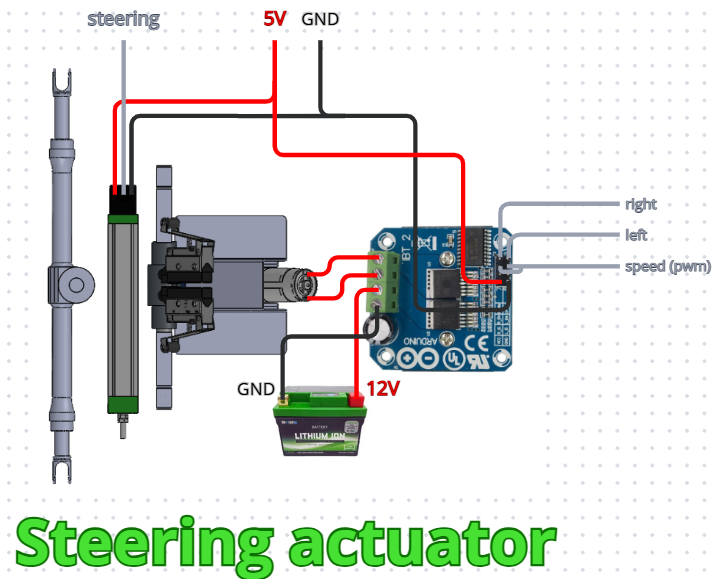
Inputs
- Right
- Left
- Speed [PWM]
The Right and Left signals determine the direction of motor rotation. They are binary signals, with each input indicating whether the motor should rotate in one of the two possible directions.
The Speed signal controls the motor speed and is provided as a PWM signal.
Outputs
- Steering
The Steering signal represents the current steering angle of the wheels, measured using a linear position sensor. It is provided as an analog signal.